
The Complete Guide to the Swahili Language: History, Culture & Common Phrases
The Swahili language has transcended its coastal origins to become one of the most widely spoken languages in Africa and beyond, serving as both a cultural bridge and a practical tool for communication across diverse communities. Whether you’re fascinated by its rich history, planning to visit East Africa, or curious to learn Swahili for travel, work, or meaningful connection, this comprehensive guide explores how this remarkable language evolved, where it’s used today, and why it’s surprisingly accessible for learners at any level.
What Is the Swahili Language?
Swahili, also called Kiswahili in its native form, is a Bantu language that originated along the East African coast as a lingua franca—a common language that enabled diverse ethnic groups to communicate, trade, and build relationships with Arab, Persian, and Indian merchants over many centuries. This unique positioning at the crossroads of African, Arab, and Asian cultures has shaped the language into what it is today: a beautiful fusion of vocabulary, sounds, and expressions drawn from multiple linguistic traditions.
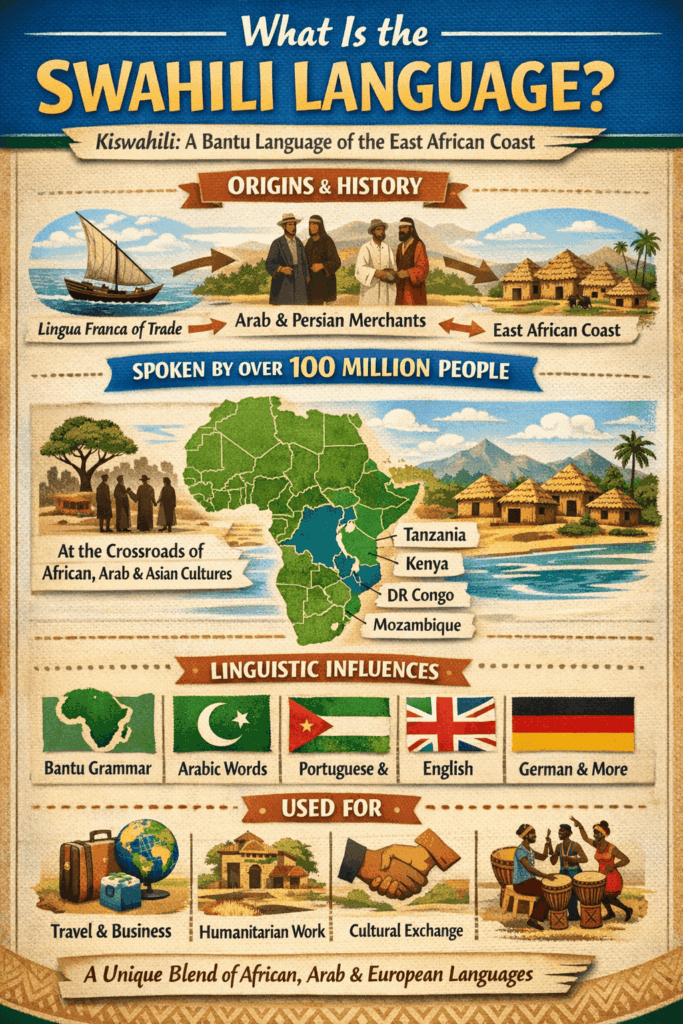
Today, the Swahili language is spoken by more than 100 million people across East Africa and beyond, including Tanzania, Kenya, Uganda, the Democratic Republic of the Congo, and parts of Mozambique, Malawi, Burundi, Rwanda, and Somalia. This widespread adoption makes it one of the most important languages on the African continent and a valuable skill for anyone engaging with the region through travel, business, humanitarian work, or cultural exchange.
The language’s grammatical structure comes from its Bantu roots, while approximately 35-40% of its vocabulary is borrowed from Arabic, with additional influences from Portuguese, English, German, and other languages that have touched East Africa’s shores throughout history. This linguistic diversity makes Swahili both unique and surprisingly familiar to speakers of many other languages.
Why the Swahili Language Is Used So Widely
The remarkable reach of Swahili across East Africa is rooted in several historical and practical factors that continue to drive its adoption today.
Historical Trade Networks For over a thousand years, coastal East African communities engaged in extensive trade with Arab, Persian, and Indian merchants who arrived by dhow across the Indian Ocean. These trade relationships created a need for a common language that could bridge the communication gap between inland African communities and foreign traders. Swahili emerged naturally from this environment, incorporating vocabulary and expressions from trading partners while maintaining its Bantu grammatical foundation.
Colonial and Post-Colonial Adoption During the colonial period, European powers recognized Swahili’s utility as an administrative language. German and later British colonial administrations in what is now Tanzania used Swahili for governance and education. After independence, many East African nations intentionally promoted the language as a tool for national unity, transcending ethnic divisions and creating shared identity across diverse populations.
Regional Lingua Franca Status In modern East Africa, Swahili serves as the common language for business transactions, educational instruction, media broadcasting, diplomatic exchanges, and everyday cross-cultural communication. Its neutrality—not being tied to any single ethnic group—makes it politically acceptable and practically valuable across the region.
Where Swahili Is Spoken and Valued
The Swahili language holds official or widely recognized status in several East African countries, each with its own relationship to the language:
Tanzania Swahili is the official national language of Tanzania and the primary language of government administration, public education from primary school onward, and everyday communication throughout the country. Tanzania’s commitment to Swahili has made it the nation where the language is most uniformly spoken across all regions and social classes.
Kenya In Kenya, Swahili serves as one of two official languages alongside English. It’s widely spoken throughout the country, taught in schools, used in government proceedings, and heard in markets, matatus (public transport), and homes from Nairobi to the coast. For travelers visiting Kenya, knowing basic Swahili phrases significantly enhances the travel experience and demonstrates cultural respect.
Uganda and Democratic Republic of Congo Millions of people in Uganda and eastern D.R. Congo use Swahili as a common language, particularly in trade and inter-ethnic communication. While not always the first language learned at home, it serves as a practical bridge language in these linguistically diverse nations.
International Presence The global importance of Swahili continues to grow. International broadcasters including the BBC, Voice of America, and Deutsche Welle offer Swahili programming. The language is taught in universities across Europe, Asia, and North America. In 2022, Swahili became an official language of the Southern African Development Community (SADC), further cementing its continental importance.
Swahili Culture: More Than Just a Language
Swahili culture is deeply intertwined with its language, creating a rich tapestry of traditions that influence music, art, architecture, cuisine, proverbs, and social customs throughout coastal and inland East Africa. Understanding this cultural dimension adds depth and meaning when you learn Swahili beyond simple vocabulary memorization.
The coastal city-states of Zanzibar, Mombasa, Lamu, and Kilwa retain stunning examples of Swahili architecture—coral stone buildings with intricately carved doors, Arabic-style courtyards, and Indian-influenced design elements. These physical structures tell the story of centuries of cultural exchange and fusion.
Swahili culture expresses itself beautifully through artistic traditions. Taarab music blends African rhythms with Arabic melodies and poetic Swahili lyrics. Traditional ngoma dances preserve ancient storytelling and celebration customs. Swahili poetry, with its strict metrical patterns and rich metaphors, has been passed down orally and in written form for generations.
Proverbs, known as methali in Swahili, carry wisdom and moral teachings from one generation to the next. These sayings reflect values like hospitality (jambo la moyo halikosi mwenyewe—a matter of the heart never lacks its owner), patience (haraka haraka haina baraka—hurry has no blessing), and community solidarity that remain central to East African social life.
Common Swahili Terms and Their Meanings
For travelers and beginners, learning these essential Swahili phrases creates immediate connection and demonstrates cultural respect:
- Jambo – Hello / Greeting (informal, especially for tourists)
- Hujambo? / Sijambo – How are you? / I’m fine (more traditional greeting exchange)
- Habari? / Nzuri – What’s the news? / Good (common daily greeting)
- Asante (sana) – Thank you (very much)
- Karibu – Welcome / You’re welcome
- Hakuna matata – No worries (made famous globally through popular culture)
- Pole pole – Slowly, slowly (a philosophy as much as a phrase)
- Rafiki – Friend
- Safari – Journey (adopted into English with the same meaning)
- Chakula – Food
These basics make the early stages of learning Swahili immediately rewarding and practical for anyone visiting Kenya, Tanzania, or other East African destinations.
Why Learning Swahili Is Easier Than You Think
Many language learners are pleasantly surprised to discover that Swahili is more accessible than they initially expected. Several features make it particularly learner-friendly:
- Consistent Pronunciation Rules Unlike English with its irregular spellings and pronunciations, Swahili follows remarkably consistent phonetic rules. Each letter generally produces the same sound regardless of context, making reading and speaking straightforward once you learn the basic sounds.
- Latin Alphabet Usage Swahili uses the familiar Latin alphabet without additional special characters or diacritical marks (aside from the occasional ng’ combination), eliminating the intimidation factor of learning an entirely new writing system.
- No Tonal Complexity Unlike many African and Asian languages that use tones to distinguish word meanings, Swahili is non-tonal. The meaning stays the same regardless of pitch, making it easier for speakers of European languages to produce and understand.
- Familiar Borrowed Vocabulary Because Swahili has absorbed words from Arabic, English, Portuguese, and other languages throughout its history, learners often recognize vocabulary connections. Words like “shule” (school), “hospitali” (hospital), and “kompyuta” (computer) are immediately recognizable.
- Logical Grammar Structure Swahili grammar follows predictable patterns, especially in verb conjugations and noun class systems. While the noun class system might seem complex initially, it operates according to consistent rules that become intuitive with practice.
Because Swahili developed as a trade language designed to facilitate communication between diverse groups, its structure prioritizes clarity and logic over complexity—perfect for new language learners seeking practical communication skills.
Conclusion
The Swahili language is far more than a practical communication tool—it’s a gateway to a vibrant cultural tapestry that spans East Africa, touching millions of lives through daily conversation, literature, music, education, and international media. Whether your goal is enriching your travel experience in Kenya or Tanzania, building professional connections across the region, or gaining deeper cultural insight into one of Africa’s most dynamic linguistic communities, learning Swahili offers both immediate practical utility and long-term cultural rewards.
Ready to start your Swahili journey? At Amani Tours Solutions, we connect travelers with authentic cultural experiences throughout Kenya, where you’ll have countless opportunities to practice your new language skills with friendly locals. Contact us today to plan your Kenya adventure and immerse yourself in the beauty of Swahili culture.
Have you learned any Swahili phrases or plan to before your East African visit? Share your experience in the comments below!